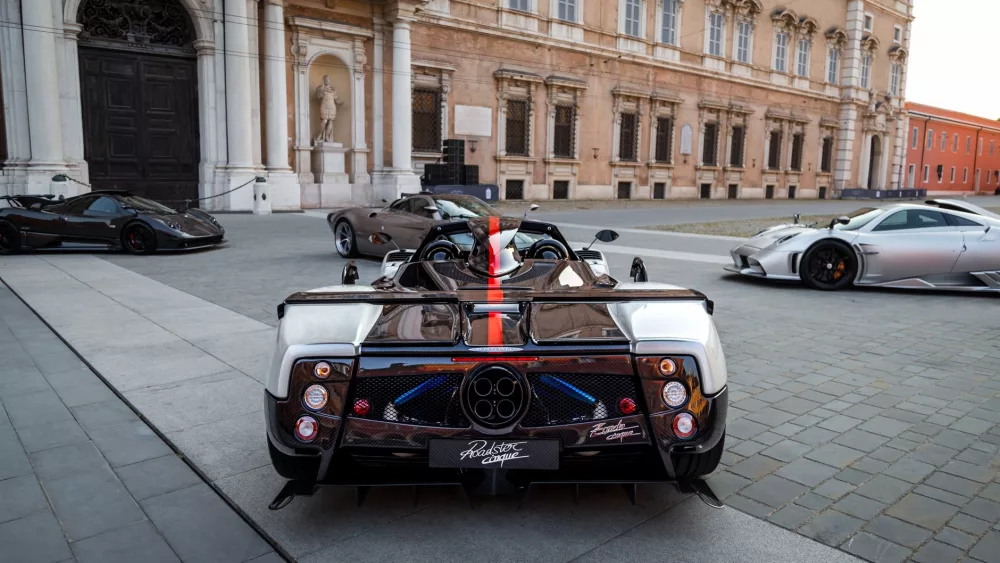
You know, there are car manufacturers, and then there's Pagani. For me, it's not just about building fast cars; it's something entirely different, almost like a master sculptor creating a moving piece of art. When I think about Pagani, I immediately picture an obsessive pursuit of perfection, a brand that blends cutting-edge engineering with an almost old-world craftsmanship you just don't see very often anymore. It's truly a unique position in the automotive world, and I find that fascinating.
The Visionary: Horacio Pagani’s Unwavering Dream
Let's be real, the story of Pagani Automobili begins with one man: Horacio Pagani. I've always been so inspired by his journey. He started out in Argentina, a kid completely obsessed with cars, sketching them and dreaming big. He even built his own car, an F3 racer, pretty early on. He then moved to Italy, which, as we all know, is the heartland of supercars. He worked at Lamborghini, where he was instrumental in their composites department, and he even tried to convince them to invest more heavily in carbon fiber technology. They said no, which, looking back, is kinda wild, isn't it?
But Horacio didn't let that stop him. He believed so strongly in his vision. So, in 1991, he founded Pagani Composite Research, and a few years later, in 1992, Pagani Automobili came into being. His guiding principle was, and still is, 'Art and Science.' He wanted to create cars that were beautiful to look at, incredible to drive, and engineered to the absolute highest standards. It's a philosophy that permeates every single nut and bolt of these machines, and I think that's why they feel so special.
The Birth of a Legend: The Zonda
Ah, the Zonda. What an introduction to the world! When the Zonda C12 first hit the scene in 1999, it blew everyone away. I remember seeing pictures of it and just being mesmerized. It wasn't just another supercar; it was an alien spacecraft, a radical departure from pretty much everything else out there. Its design was incredibly distinctive, with that quad exhaust layout that became an instant Pagani signature. Honestly, it was just breathtaking.
What always struck me about the Zonda wasn't just its looks, though. It was powered by a Mercedes-AMG V12 engine, a partnership that continues to this day, and it delivered insane performance. But Pagani didn't just bolt on an engine; they integrated it seamlessly into a chassis that was largely made of carbon fiber. Horacio was a true pioneer in composite materials, and the Zonda showcased that expertise perfectly. Over the years, we saw numerous iterations, each one seemingly more extreme and exclusive than the last:
- Zonda S: More power, improved aerodynamics.
- Zonda F: Named after Juan Manuel Fangio, a significant leap in performance and refinement.
- Zonda Cinque: A super-limited, track-focused beast with unique carbon-titanium weave.
- Zonda R: A track-only monster, utterly uncompromising, built purely for speed and a visceral experience.
- Zonda Revolución: The absolute pinnacle of Zonda evolution, a final, mind-bending expression of what's possible on a track.
Each Zonda was a masterpiece, hand-built with an almost insane level of attention to detail. I mean, they were just incredible machines, aren't they?
The Next Chapter: The Huayra
After the Zonda's incredible run, many wondered how Horacio could possibly top it. Well, he did. In 2011, Pagani unveiled the Huayra, and it was clear that the company had evolved. The Huayra was designed to be a more sophisticated machine, still incredibly fast, but with a greater emphasis on luxury, comfort, and advanced aerodynamics. I think it shows a real maturity in their design philosophy.
One of the most striking things about the Huayra, for me anyway, is its active aerodynamics. Those four independent flaps that adjust in real-time? That's just genius, allowing the car to adapt its downforce and drag on the fly, which is something you just don't see on many road cars. Again, it used a bespoke Mercedes-AMG twin-turbo V12, tuned specifically for Pagani, and it was a powerhouse. The interior? Oh my goodness, the interior of a Huayra is a work of art in itself, full of exquisite leather, polished metals, and exposed carbon fiber. It's like a steampunk masterpiece meets ultra-luxury.
Huayra Variants We Can't Forget
- Huayra BC: Named after Benny Caiola, Horacio's first customer and close friend, this was a lighter, more powerful, and more aggressive version.
- Huayra Roadster: Bringing the open-top experience without sacrificing performance or structural integrity.
- Huayra Roadster BC: The ultimate open-top Huayra, taking everything great about the BC and making it a convertible.
- Huayra R: Following the Zonda R's footsteps, this is a track-only, naturally aspirated scream machine, just pure, unadulterated performance.
Utopia: The Future, Rooted in Tradition
And now, we have the Utopia. When this car was revealed, I felt a sense of relief, actually. Why? Because in an era where pretty much every new hypercar is going hybrid or electric, Pagani did something different. They stuck to their guns. The Utopia still features a glorious Mercedes-AMG V12 engine, and get this, you can even get it with a proper manual gearbox! For a lot of enthusiasts like me, that's a huge deal. It shows they're listening to what people really want from an analog driving experience.
The Utopia feels like a natural progression. It’s cleaner, more elegant than the Huayra, but still unmistakably a Pagani. It's lighter, more powerful, and continues that incredible attention to detail. It's a car that somehow manages to feel both futuristic and timeless at the same time, which, if you ask me, is a massive achievement.
The Essence of Pagani: Craftsmanship Beyond Compare
What really makes a Pagani a Pagani, beyond the speed and the looks? It's the artistry, the sheer human effort. Every single component, even the smallest screw, is designed and crafted with an almost insane level of precision. I mean, they literally develop custom fasteners with the Pagani logo on them. Think about that for a second! The carbon fiber weave is perfectly aligned across panels, the leather interiors are stitched by hand, and the metal components are often machined from solid billets. It's less a production line and more a workshop where artisans are at work.
For me, a Pagani isn't just a car; it's a statement. It's a belief that a machine can be both incredibly functional and breathtakingly beautiful, a harmonious blend of art and engineering. You can truly feel the passion and obsession in every curve and every seam. That's why I think they occupy such a special place in the automotive universe. They don't churn out thousands of cars; they create a select few, each one a unique expression of Horacio Pagani's vision. And honestly, I wouldn't have it any other way.